


Block-A-Day 135 – The Bloodmobile
Today I continue my quest in creating and posting one block a day of the fabulous That Town And Country Quilt by the lovely Susan Claire. This is day one hundred and thirty-five of that project.
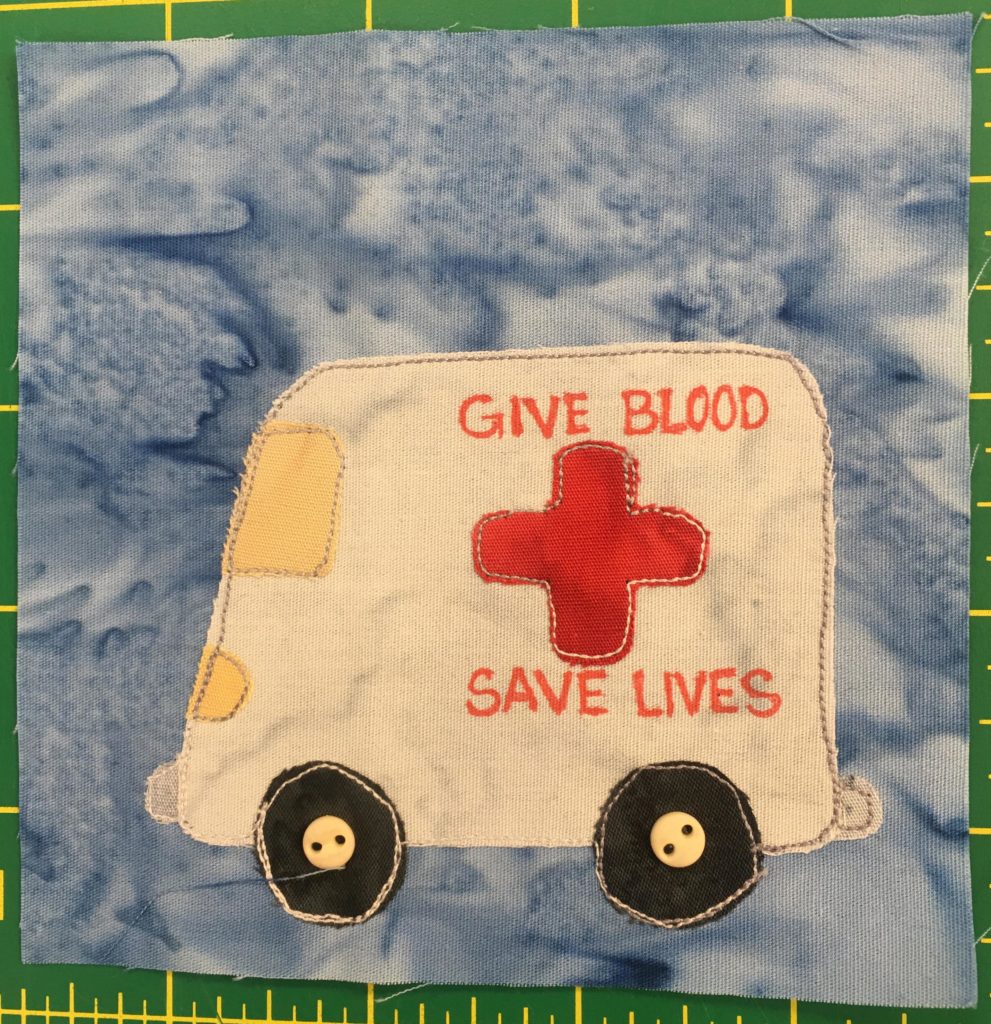
The Bloodmobile is in That Town having a blood drive. I’m sure many of you have given blood; I know I have. I have never had a transfusion, but my parents used a lot of blood before they passed away. I kind of think of it as a debt. I got to looking into blood donation and learned some interesting things. Lucky you, I’m going to share my discoveries with you.
- In 1628 Dr. Harvey discovered the circulation of blood. I can’t imagine a time when we didn’t know blood circulated in our bodies.
- In 1665 the first successful transfusion was performed on a dog.
- In 1667 the first successful transfusion in France and England involved sheep blood to humans.
- In 1818 the first human-to-human transfusion was a success!
- From 1873-1880 U.S. Doctors attempt to substitute milk from cows, goats, and humans in transplants.
- In 1884 because of adverse reactions, saline replaced milk.
- In 1901 Blood Types are found.
- In 1907 the first transfusion using typing and cross-matching was performed.
- Through 1939-1940 Rh factor is discovered.
- In 1940 the U.S. established blood banks.
- In 1941 the U.S. began the National Blood Donor Service to collect blood for the U.S. military.
- In 1945, when the Red Cross wrapped up its war collection efforts, it had collected more than 13 million pints.
- In 1947 all blood started getting ABO typing and syphilis testing.
- In 1948 the first civilian collection center was opened.
- By 1949 there were 1500 hospitals, 46 community centers, and 31 Red Cross regional collection sites.
- In 1950 the U.S. stepped up once again as the collection agency for the Korean war.
- In 1956 a national blood clearinghouse was created.
- In 1970 the U.S. moved to an all-volunteer donor system (makes you wonder what it was before?)
- In 1971 Hepatitis B was added to the list of tests.
- In 1985 AIDS testing began.
- In 1992 they began being able to test for HIV1 and HIV2.
- In 2002 Hepatitis C is added.


